C18150 vs C18200: Which Chromium Copper to Put on the Drawing
October 13, 2026
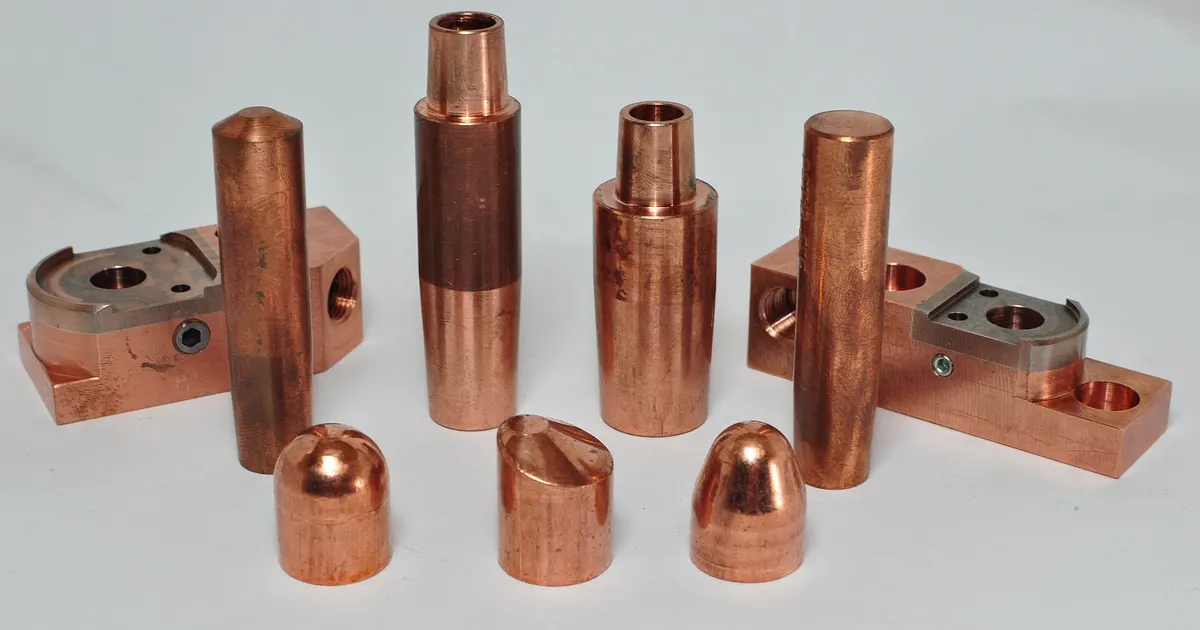
Chromium copper and chromium zirconium copper are the workhorse high strength coppers. They make resistance welding electrodes, holders, mold inserts and hot, stiff contact parts. On a bar they look identical, and on a drawing they are often swapped without comment. This guide shows what separates them, when the difference matters and how to write the callout so a shop quotes the right alloy.
What the two alloys are
C18200 is chromium copper, with roughly 0.6 to 1.2 percent chromium and the rest copper. It is the standard general purpose electrode material.
C18150 is chromium zirconium copper. It carries about 0.5 to 1.5 percent chromium and a small zirconium addition, in the range of 0.05 to 0.25 percent. Zirconium sharpens the precipitation hardening and improves resistance to softening at temperature.
Both belong to RWMA Group A Class 2, which is why shops and drawings treat them as one family. In European standards the near equivalents are the CuCr1 and CuCr1Zr grades, so check the designation when a drawing mixes systems. Our page on RWMA classes for copper electrodes explains the class system.
Side by side
| Property | C18200 chromium copper | C18150 chromium zirconium copper |
|---|---|---|
| Alloying | Cr 0.6 to 1.2% | Cr 0.5 to 1.5%, Zr 0.05 to 0.25% |
| RWMA class | Class 2 | Class 2 |
| Conductivity, aged | About 80% IACS | About 80% IACS |
| Hardness, aged | Roughly 75 to 90 HRB | Roughly 75 to 90 HRB |
| Resistance to softening | Good | Somewhat better |
| Machinability rating | About 20 | About 20 |
| Typical use | General electrodes, holders | Hot, heavy duty electrodes and contacts |
Figures are published typical values for the alloy, not a promise from any shop or mill. Both pages in the copper grade reference carry the same data, for C18200 and for C18150.
The honest summary is that on a data sheet the two look almost the same. The difference shows up in service, at temperature and under load.
Where C18150 earns its place
Zirconium helps the alloy keep its hardness after repeated heating. For a part that sees many weld cycles, high duty cycles or continuous elevated temperature, that can mean longer tip life. Typical examples are electrodes welding coated steel at high current, cooling plates and mold parts that run hot and stiff, as well as contacts that carry current while warm.
For a light duty electrode that sees modest heat, C18200 does the job. Paying for the more resistant alloy is not worth it if the part never gets hot enough to use the difference.
The right way to decide is to look at tip wear or part life on the alloy you use today. If it mushrooms or softens, test the other alloy on a trial lot. Do not assume a datasheet gain translates to your process.
A short decision guide
Start with the service, not the datasheet.
- General production welding of steel at moderate duty. C18200 is the normal choice and is widely stocked.
- High duty cycles, coated steel or heavy sections. Consider C18150, because the electrode tip sees more heat and more cycles.
- Parts that carry current and heat at the same time. Contacts, bus bar clamps and cooling parts may justify C18150 if they run warm all day.
- Mold inserts and heat sinks. Both are used. Check what your mold maker prefers, because thermal conductivity and wear drive the choice.
- You do not know. Say “C18200 or C18150, supplier to state” and compare quotes. If one is cheaper and the other is no better in your service, take the cheaper.
The conductivity figure is the same in practice, so electrical performance rarely decides it. What decides it is how the part ages in service.
Supply and lead time
Supply is a real factor. C18200 is the more common stock item in many regions, in rod, bar, plate and forged shapes. C18150 stock depends on the supplier and the size, and some product forms may be made to order. A shop that quotes C18150 for a one off part may wait on material, while the same part in C18200 ships from stock. Ask about material lead time before you ask about cycle time. Copper lead times shows where the weeks go on a typical order.
Quote both alloys when you can accept either. A shop that holds one in stock will show a shorter date, and you choose between date and performance with real numbers.
How both alloys get their properties
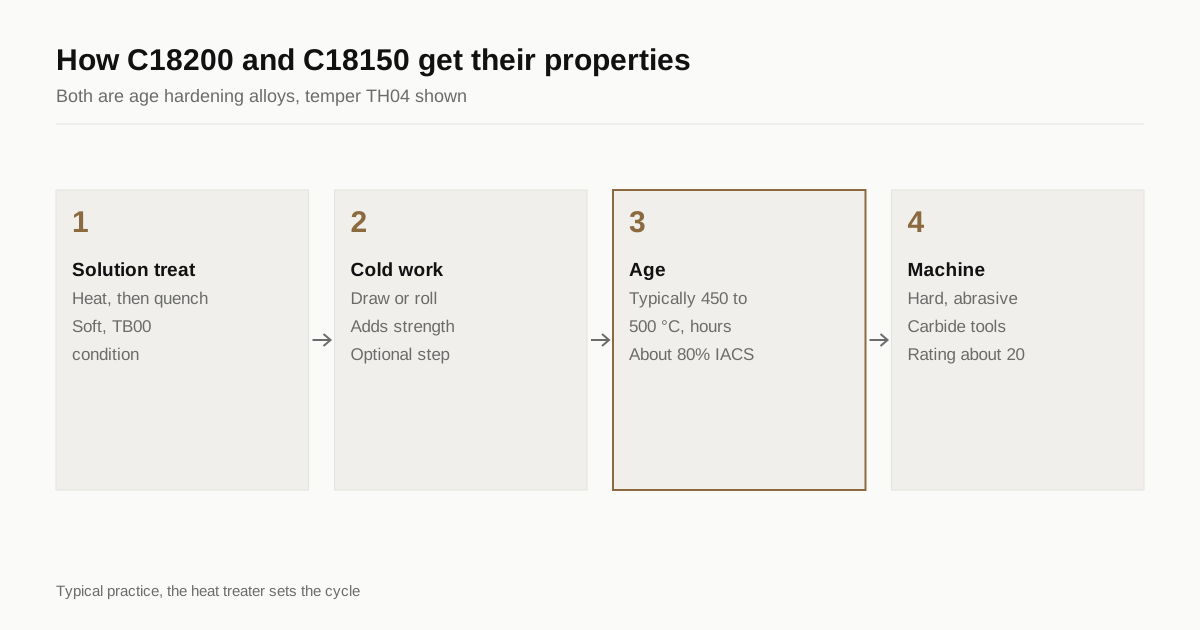
These are age hardening alloys. They reach their strength by heat treatment, not by alloying alone.
- Solution treat. Heat to a high temperature so the alloying elements dissolve, then quench. The metal is soft and ductile. This is the TB00 condition.
- Cold work, optional. Drawing or rolling adds strength. This is part of TH04 temper.
- Age. Hold at a moderate temperature, typically in the range of 450 to 500 °C for a few hours, so fine particles precipitate and harden the metal and raise conductivity.
The mill usually supplies bar in a finished temper such as TH04, which is solution treated, cold worked and aged. A shop that machines it receives a hard, abrasive material. Copper tempers explained covers the codes and what each means for machining.
Machining notes
Neither alloy is easy. The machinability rating is about 20, the same as pure copper, but the hard temper wears tools faster than soft copper does. Expect carbide tooling, moderate speeds and sharp edges.
Some shops machine in the solution treated condition because it cuts more easily, then send the part out for aging. That route saves cycle time but adds a heat treatment step and a lead time, and the part can change size slightly when it ages. If tight dimensions matter, say which features must hold after aging, and let the shop plan for the movement.
Overheating during machining or grinding can soften the surface, so keep coolant on and avoid dwelling. Welded or brazed joints on these alloys also soften the area around the joint, which is worth knowing for assemblies. Read joining machined copper parts before designing a brazed electrode.
How to write the callout
The three ways to get it wrong are naming only the family, omitting the temper and leaving substitution unspoken. A clean callout looks like this:
Chromium zirconium copper, UNS C18150,
RWMA Group A Class 2,
temper TH04 (solution treated, cold worked, aged).
Substitution of C18200 not permitted without approval.
Or, if you accept either:
Chromium copper, UNS C18200 or chromium zirconium copper, UNS C18150,
RWMA Group A Class 2, temper TH04.
Supplier to state which alloy is quoted.
Do not print an ASTM specification you are not sure of. For these alloys the right standard depends on the product form, so confirm it with your stockist. See how to specify copper on a drawing for the general approach and our editorial standards for how we treat specification numbers.
Proof you can ask for
- The mill certificate showing the alloy, heat number and chemistry. See copper material certificates.
- A hardness reading on the finished part. Aged material sits in a known band.
- A conductivity reading, which shows whether aging worked. Around 80 percent IACS is the typical aged value. The method is in IACS conductivity testing.
A part that reads soft and conductive but not hard, or hard and not conductive, tells you which treatment step went wrong.
Checklist for the RFQ
- Name the alloy by UNS number, and say whether substitution is allowed
- State the RWMA class and the temper
- Say whether machining is before or after aging, if you care
- Mark dimensions that must hold after any heat treatment
- Give the service condition if the part runs hot, so the shop can advise
- Ask for the certificate, hardness and conductivity records you need
The welding electrodes page shows the parts these alloys usually make. Send the drawing through the RFQ form. We match it with up to 3 shops that cut copper and reply within 24 business hours.
Frequently asked questions
Can I substitute C18200 for C18150?
Sometimes, but not silently. Both are RWMA Class 2 with similar conductivity, and many parts run fine on either. C18150 resists softening and creep at higher temperature, so a hot, heavy duty part can wear faster in C18200. Say on the drawing whether substitution is allowed.
What conductivity should I expect from these alloys?
Around 80 percent IACS in the fully aged condition, for both. A reading well below that usually means the part was not aged correctly, not that the alloy is different.
Do these alloys machine well?
No. Both rate about 20 on the scale where free-cutting brass is 100, and the aged temper is abrasive on tooling. Many shops rough in the solution treated condition, age, then finish, and that sequence is worth stating on the drawing.
Need a quote for this part?
Send the drawing. We match you with up to 3 copper shops and reply within 24 business hours.
Get matched with a copper machining shop