Copper Cold Plates: How the Channels Are Cut, Sealed and Joined
October 15, 2026
A cold plate pulls heat from a part, often a power module, laser diode or battery cell, and passes it to a flowing liquid. Copper is a popular material because it spreads heat well. The plate is simple in concept and demanding in practice, because the channels must be clean, the lid must seal and the contact face must be flat. This guide follows the build from channel to lid and sets out what each choice costs.
Four ways to build a cold plate
| Construction | How the fluid path is made | Sealing | Typical use |
|---|---|---|---|
| Milled channel with bolted lid | Channel milled in the base, flat lid on top | O-ring and screws | Prototypes, serviceable plates, moderate pressure |
| Milled channel with brazed or soldered lid | Same channel, lid joined by heat | Metallurgical joint | Production plates, higher pressure |
| Milled channel with friction stir welded lid | Same channel, lid stir welded | Solid state weld | Larger plates, no filler or flux |
| Tube in plate | Groove milled, copper tube pressed or bonded in | Tube wall is the seal | Simple loops, lower cost |
Gun drilled holes with plugged ends are a fifth route for straight channels in thick blocks. Your thermal design decides which construction fits, and the machining shop follows.
Cutting the channels
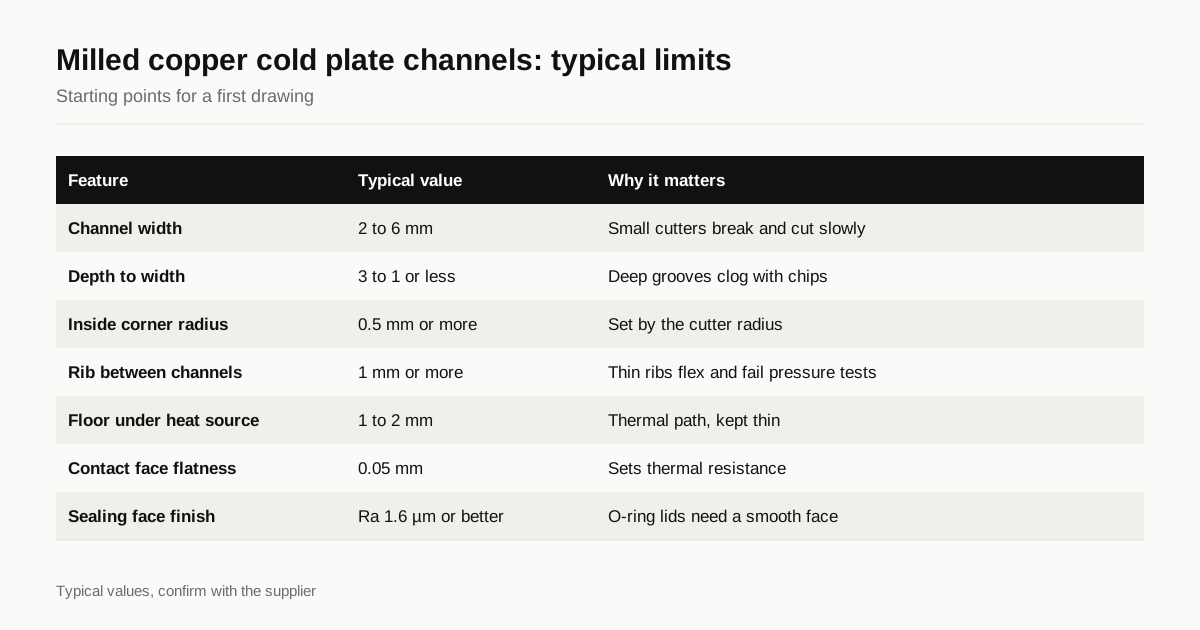
Channels are milled with end mills, ball mills or corner radius cutters. Copper is soft and gummy, so cutters must be sharp and chips must leave the groove. The practical limits follow from the cutter.
- Width. Channels from about 2 to 6 mm are common. Narrower ones need small cutters that break easily and run slowly.
- Depth. Deep, narrow grooves clog with chips. A depth to width ratio above about 3 to 1 slows the cut sharply.
- Inside corners. The cutter radius sets the corner radius. A radius of 0.5 mm or more on channel corners is easier and safer than a sharp corner.
- Wall between channels. A rib of 1 mm or more is typical. Thinner ribs flex under the cutter and can fail in pressure testing.
- Floor thickness. The metal between channel and contact face is a thermal path. Keep it as thin as strength allows, often 1 to 2 mm.
All of these are typical, and a shop’s tools and machine decide what is realistic. Show channel layout in a STEP model so the shop sees it before quoting. Copper heat sink machining covers fin and groove rules that carry over.
Burrs and chips in the channel
Burrs in a cold plate are not cosmetic. A burr that breaks free travels with the coolant and can block a nozzle or jam a pump. Channels have edges that are hard to reach, so deburring has to be planned.
Methods include brushing with fine nylon or wire tools, abrasive flow and thermal or chemical deburring where specified. After cutting, the channels need flushing and a particle check. Say on the RFQ what cleanliness level you need and how it is proved, for example a flush with filtered fluid and a particle count on the effluent. Deburring copper parts covers the options and their cost.
Closing the channel: the lid
Bolted lid with O-ring. A groove in the base or the lid holds an elastomer ring and screws clamp the lid. It can be opened for service and is the cheapest to prototype. It needs a flat sealing face, typically Ra 1.6 µm or better, a groove cut to a standard O-ring size and enough screws and spacing for even clamping. Pressure and temperature set the elastomer. Elastomers are permeable to water vapor over time, which matters in sealed liquid loops with long life.
Brazed or soldered lid. The lid is joined with filler metal in a furnace, so the plate becomes one piece. It suits production and higher pressures. Furnace brazing heats the whole part and anneals it, so the copper comes out soft. Flux residue or oxide in channels has to be controlled, and some brazes use hydrogen atmospheres, which need oxygen free copper. See joining machined copper parts.
Friction stir welded lid. A rotating tool stirs the lid into the base along the joint line without melting. It makes a strong leak tight joint without filler or flux, but copper is a demanding material for it because of its high thermal conductivity, and few shops do it. Expect a flat lid and a weld path set clear of the channel.
Tube in plate. A copper tube is pressed or bonded into a milled groove. It is simple, the tube is the pressure boundary, and thermal contact depends on how well the tube sits in the groove. Plates with tubes cost less than channel plates but spread heat less evenly.
Design the plate so it can be cut
A few design choices make a plate cheaper and more reliable without touching the thermal result.
- Use one channel depth. Changing depth along the path means extra tool changes and extra programming.
- Keep channel turns generous. Tight serpentine turns cost cutter life and pressure drop.
- Give the cutter an exit. A channel that ends in a blind pocket traps chips. A short lead out or a drilled sump helps.
- Put ports where a tool can reach. Inlet and outlet fittings need a spot face and a thread, and the thread must not open into a burr in the channel.
- Leave stock on the lid land. The lid land is the sealing surface, so give it enough width for the seal and the screws.
Show datums for the contact face and the sealing face separately, because they are finished in different steps.
What drives the price
Machining time is the largest share. Total channel length, depth and corner count decide it, because every extra meter of groove costs cutter wear and minutes. Plates with brazed or welded lids add a joining step, fixtures and inspection. A bolted plate has cheaper joining but needs the O-ring groove and a flat lid. Leak testing, flushing and particle counts add handling time and equipment. Quantity matters: setup and fixtures are a fixed cost, so a run of ten costs much less per plate than one. If you can show two concepts, such as a milled channel and a tube in plate, ask for both quotes and compare them against your thermal target.
Flatness and contact face
The contact face carries the thermal interface to your heat source. Flatness and finish set the thermal resistance. Typical callouts are flatness of 0.05 mm over the contact area and a finish of Ra 0.8 to 1.6 µm. Bolted lids and brazing can distort the plate, so ask when flatness is measured: before or after the lid goes on. Often the face is finished after joining. Copper surface finish lists what each finish costs.
Leak testing
Every closed plate needs a pressure or leak test before it is trusted. Common tests are pressure decay with air and helium sniffing for tight leak rates. The test pressure, the hold time and the acceptable leak rate all go on the drawing, with a proof pressure above the working pressure. See cold plate leak testing for the methods and what to specify.
Material and coolant
C11000 is common and economical. C10100 is used when hydrogen brazing or vacuum service demands oxygen free copper. Both conduct close to 100 percent IACS. Use deionized or inhibited water glycol, and check the coolant against the metals in the loop. Mixing copper and aluminum in one wetted path risks galvanic attack of the aluminum, so many designers choose copper throughout. The comparison in copper against aluminum parts covers the trade.
What to write on the RFQ
- STEP model with channel layout and a drawing with tolerances
- Grade and temper, and whether the part can be annealed by brazing
- Lid type and sealing method, with O-ring size where used
- Contact face flatness and finish, and when it is measured
- Cleanliness requirement and proof method
- Leak test method, pressure, hold time and acceptance level
- Quantity and repeat schedule
The heat sink machining page shows related parts. When the drawing is ready, send it through the RFQ form. We match it with up to 3 shops that cut copper and reply within 24 business hours.
Frequently asked questions
What is the usual way to make a copper cold plate?
Mill a channel into a thick copper base and close it with a lid. The lid is bolted with an O-ring, brazed, soldered or friction stir welded, depending on pressure, leak tolerance and cost. A simpler alternative presses copper tube into a milled groove.
How narrow can a milled channel be?
Channels of 2 to 6 mm wide are common, and narrower ones are possible with small cutters at a higher price. Depth is limited by cutter length and chip clearing, and the ratio of depth to width drives how slow the cut becomes.
Can I use copper and aluminum in the same cooling loop?
Avoid it unless the loop chemistry is designed for mixed metals. Copper in contact with aluminum through coolant can cause galvanic corrosion of the aluminum. Choose one metal for the wetted path or use a coolant and inhibitors designed for the combination.
Need a quote for this part?
Send the drawing. We match you with up to 3 copper shops and reply within 24 business hours.
Get matched with a copper machining shop